



1. What does it mean for an offender to voluntarily repair, compensate for damages, or remedy consequences?
According to the guidance in Clause 2, Article 2 of Resolution 04/2025/NQ-HĐTP, an offender who voluntarily repairs, compensates for damages, or remedies consequences falls into one of the following cases:
– The offender personally or agrees for their parents, or other persons (spouse, children, siblings, friends, etc.) to repair, compensate for damages, or remedy the consequences caused by the offender’s criminal act;
– The offender is not responsible for repairing, compensating for damages, or remedying the consequences caused by their criminal act (e.g., compensation for damages is the responsibility of the owner of a highly dangerous source or the civil responsibility of other defendants in the same case) but has voluntarily used their own money, property, or agreed for their parents, or other persons (spouse, children, siblings, friends, etc.) to repair, compensate for damages, or remedy the consequences caused by the offender’s criminal act;
– The offender voluntarily or agrees for their parents, or other persons (spouse, children, siblings, friends, etc.) to use money or property to repair, compensate for damages, or remedy the consequences caused by the offender’s criminal act, but the victim, civil plaintiff, or their legal representative refuses to accept, and the said money or property has been handed over to the procedural agency, enforcement agency, or other competent agency for management to carry out the repair, compensation for damages, or remedy of consequences caused by the offender’s criminal act;
– There is evidence demonstrating that the offender voluntarily or agrees for their parents, or other persons (spouse, children, siblings, friends, etc.) to use money or property to repair, compensate for damages, or remedy the consequences caused by the offender’s criminal act, but the victim, civil plaintiff, or their legal representative refuses to accept, and they have kept or deposited the said money or property, ready to carry out the repair, compensation for damages, or remedy of consequences when required.
When applying this mitigating circumstance, the extent of the reduction in criminal liability depends on the offender’s initiative and activeness in repairing, compensating for damages, and remedying consequences, as well as the effectiveness and extent of the repair, compensation, and remedy.
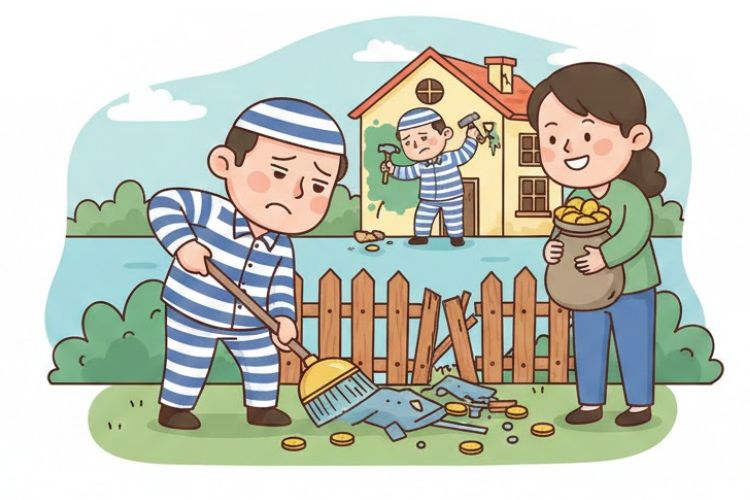
2. Is an offender voluntarily repairing, compensating for damages, or remedying consequences a mitigating circumstance for criminal liability?
The mitigating circumstances for criminal liability are stipulated in Article 51 of the Criminal Code of Vietnam 2015 (amended by Points a, b, Clause 6, Article 1 of the 2017 Law amending the Criminal Code) as follows:
– The offender has prevented or minimized the harm caused by the crime;
– The offender voluntarily repairs, compensates for damages, or remedies consequences;
– Committing a crime in a case of exceeding the limits of legitimate self-defense;
– Committing a crime in a case of exceeding the requirements of a state of emergency;
– Committing a crime in a case of exceeding the necessary extent when apprehending an offender;
– Committing a crime under mental provocation caused by the victim’s unlawful act;
– Committing a crime due to particularly difficult circumstances not caused by oneself;
– Committing a crime but causing no damage or minor damage;
– Committing a crime for the first time and falling into a less serious case;
– Committing a crime because of being threatened or coerced by another person;
– Committing a crime in a case of limited cognitive ability not caused by one’s own fault;
– Committing a crime due to backwardness;
– The offender is a pregnant woman;
– The offender is 70 years old or older;
– The offender is a person with severe or especially severe disability;
– The offender is a person with an illness that limits their cognitive ability or their ability to control their behavior;
– The offender confesses voluntarily;
– The offender makes a sincere declaration, shows remorse;
– The offender actively cooperates with competent authorities in detecting crime or during the resolution of the case;
– The offender has performed meritorious deeds to atone for their crime;
– The offender is a person with outstanding achievements in production, combat, study, or work;
– The offender is a person who has rendered meritorious service to the revolution or is the parent, spouse, child of a martyr.
Thus, an offender who voluntarily repairs, compensates for damages, or remedies consequences is considered a mitigating circumstance for criminal liability.
3. Some notes when applying mitigating circumstances for criminal liability
– When deciding on a penalty, the Court shall base its decision on the provisions of the Criminal Code, considering the nature and degree of social danger of the criminal act, the offender’s personal background, mitigating circumstances, and aggravating circumstances for criminal liability.
– The Court may decide on a penalty below the minimum level of the applicable penalty framework but still within the immediately lighter penalty framework of the article when the offender has at least two mitigating circumstances specified in Clause 1, Article 51 of the Criminal Code of Vietnam 2015.
– Mitigating circumstances belonging to a co-offender shall only apply to that co-offender.
– Mitigating circumstances that have been stipulated in this Code as elements for defining a crime or a penalty framework shall not be considered as mitigating circumstances when deciding on a penalty.
– When imposing a prison sentence not exceeding 03 years, based on the offender’s personal background and mitigating circumstances, if it is deemed unnecessary to enforce the prison sentence, the Court shall grant a suspended sentence and set a probationary period from 01 year to 05 years, and the offender shall fulfill obligations during the probationary period according to the provisions of the Law on Execution of Criminal Judgments.